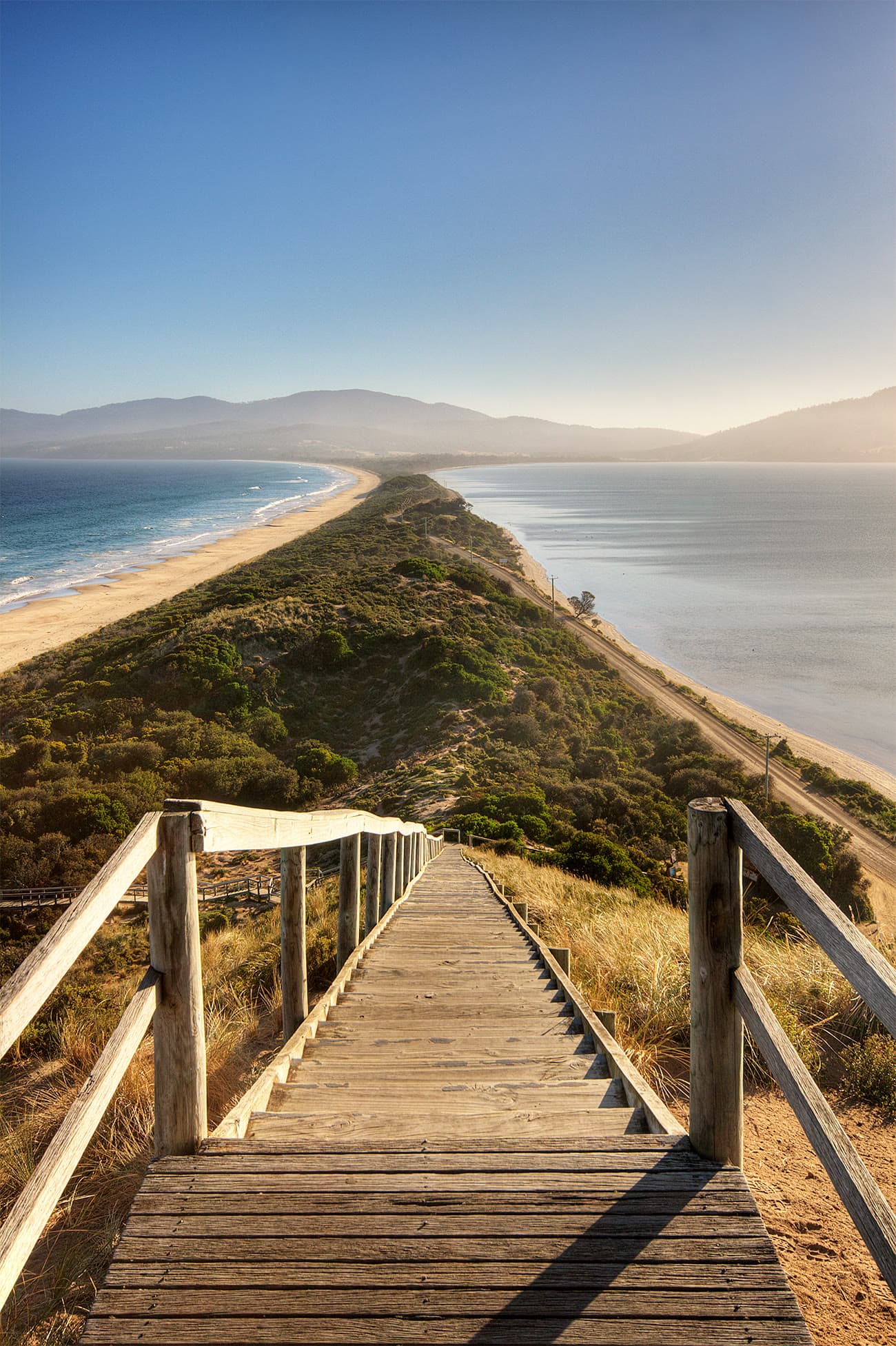
The icon
What is The Neck on Bruny Island?
A strip of sand that makes one island out of two — and the lookout everyone already has on their phone.
- North meets South
- Isthmus
- The stairway view
- Truganini Lookout
- Little penguins
- After dusk
- Shearwaters (typical)
- Sep–Apr
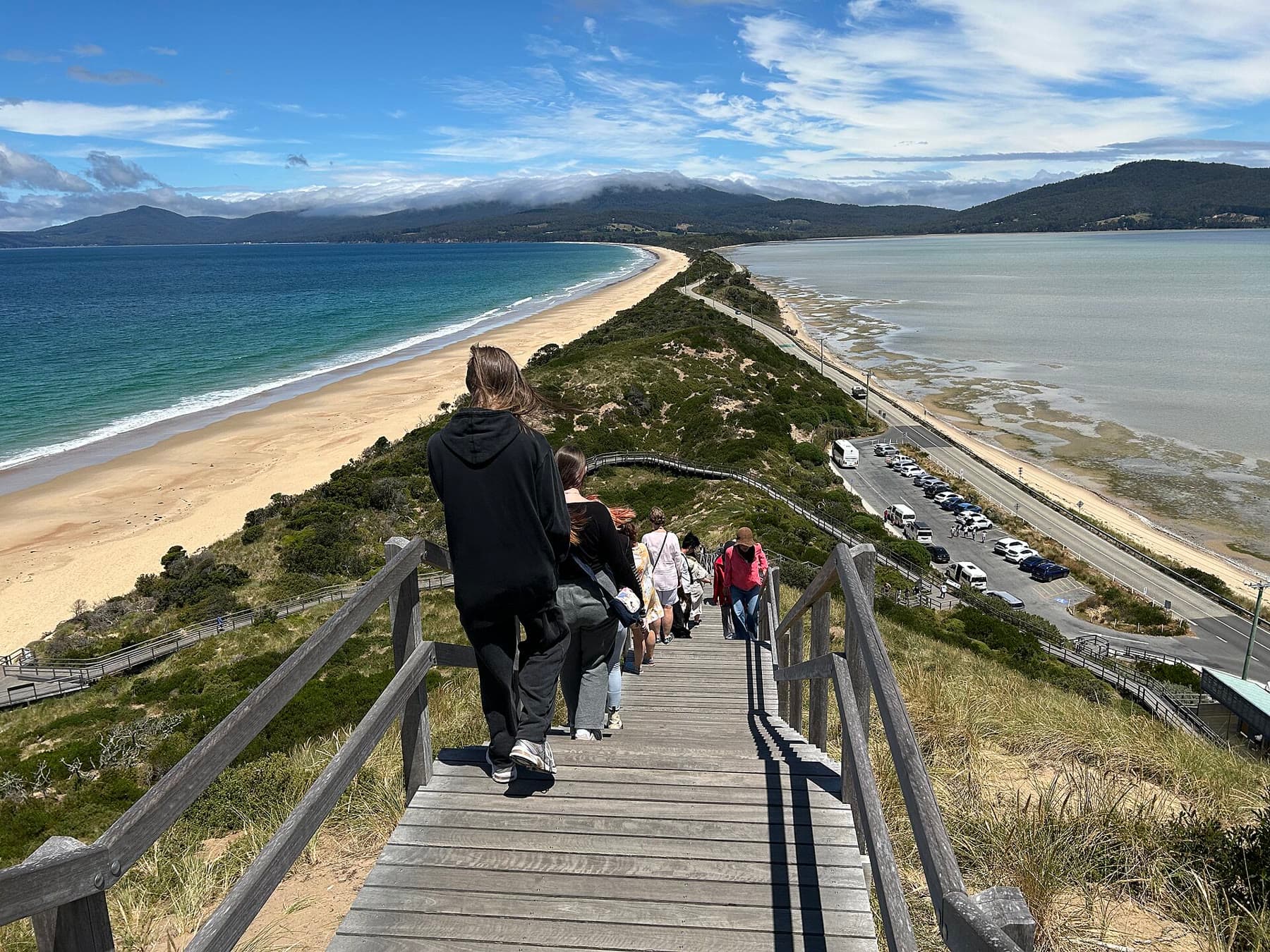
The Neck is the narrow sand isthmus that joins North Bruny and South Bruny. A steep timber stairway leads to Truganini Lookout, with beaches on both sides of the strip. After dusk, little penguins come ashore at the rookery below — stay on the viewing platforms and do not use flash.
Definition
The Neck. The isthmus — dune, road, and beach — that physically connects Bruny’s two main landmasses. The lookout above it is a separate short climb, not the whole feature.
Verify. Hours, prices, tour operators, and property details change. Confirm with the business or Parks Tasmania before you travel. This guide is independent and informational only.
The isthmus first, then the stairs
From the road, The Neck looks like a mistake in the map: too thin to be a connection, too busy to be wilderness. It is both. On one side, the protected curve toward Adventure Bay; on the other, a longer, more weather-exposed beach. The road and the dunes share the same strip of sand. Cars still use it at night. That is the first practical fact: this is a through-route, not a pedestrian mall.
The lookout is named for Truganini, a Nuenonne woman whose life is part of Tasmania’s most painful colonial history. Bruny — Lunawanna-alonnah — is her country. The view is spectacular. It is also a memorial landscape. Behave like it. Do not use the name as a caption joke.
The climb is a steep timber stairway to a platform. Counts published on blogs disagree, so we will not invent a step number. If you cannot do steep stairs, you can still stand on the isthmus and understand the geography. That is the definition: two islands, one neck.
Wind at the top is not decorative. Hold onto hats and phones. Layers that felt silly in Hobart feel obvious here. The photograph everyone already has is south along the strip — two weathers, one road. It is worth the climb. It is not worth an hour of platform hogging when the food trail is still ahead on a day trip.
Can you see penguins on Bruny Island?
Yes. Little penguins (Eudyptula minor) come ashore after dusk at The Neck rookery. Short-tailed shearwaters (muttonbirds) use the same landscape in the warmer months — typically arriving in spring and leaving by autumn, which is why this page’s chip says Sep–Apr as a typical window, not a booking.
This is not a floodlit stadium. There is no guaranteed parade. Some nights are quiet. Some nights the platforms are crowded with people who brought the wrong light. Viewing is not a ticketed show in the Phillip Island sense. That does not mean you can walk onto the beach with a torch.
Rules that do not change when the signage is updated:
- Stay on the viewing platforms and formed paths.
- No flash. No bright white torch on the beach. Use only what rangers or signs allow (often a dim red light, and sometimes not even that).
- Do not pick up, chase, or block a bird.
- Keep voices down. The show is not for you; you are tolerated beside it.
- Never stand in the road to film. Cars still use The Neck at night.
If you want a high-probability, high-infrastructure penguin evening, Phillip Island is a different product in a different state. Bruny’s version is wilder and more contingent — which is why it is worth an overnight stay. The longer ethics-and-timing note is little penguins at The Neck.
Penguins are why a same-day return usually fails this question. They come ashore after dusk, after typical last-ferry thinking. Check official SeaLink sailings if you are tempted to try a very late return; do not assume one exists that makes the rookery safe and the drive home kind.
Practicalities
- There is parking near the lookout / rookery. It fills on summer weekends. Do not create a third lane of cars on the isthmus.
- There is a campground nearby (Parks). Useful if dusk is the point of the trip. Book via Parks Tasmania. Facilities are basic.
- A parks pass is not the usual requirement for the lookout itself; the national park boundary is a different line (Cape Bruny, Jetty Beach, Cloudy Bay). Still read signs. Boundaries and fee practice can be updated.
- The climb is a day-trip staple from Hobart once you have crossed from Kettering. Penguin viewing is why overnight stays exist.
- Toilets and boardwalks are visitor infrastructure, not an invitation to leave the path.
Drive times, as shapes not a timetable: roughly 15–20 minutes from Roberts Point to The Neck; another 15–20 minutes on to Adventure Bay. The lighthouse is a different, much longer south.
A small ethics note
Drones, speaker-phone commentary, and stepping off the path for “a better angle” are how rookeries degrade. If a ranger or volunteer asks you to move, move. The photograph at the top of the stairs is already better than the one you would get from the dune.
Hooded plovers and other shorebirds nest on Tasmanian beaches. Give them space. Dogs do not belong on penguin platforms or in the dunes. The kids guide covers how to make the stairs and the dusk visit work for families without turning the rookery into a playground.
How The Neck sits in a trip
Daytime only is the honest day-trip version: climb, photograph, leave with slack for Great Bay.
Daytime plus dusk is the honest overnight version: do the lookout when the light is easy, come back after dinner, drive home slowly.
The Neck as a camp is for people who want the rookery without a long return. Book; do not freelance a tent on the sand.
If you are still choosing a base, Adventure Bay is the classic first night because the dusk drive is short and known. Dennes Point is prettier for a quiet house and worse for a late rookery run. See where to stay.
The Neck is the image that brought you. It is also a working isthmus with birds that do not perform on cue. Treat the stairs as a destination, not a five-minute pull-off, and treat the penguins as a privilege you might not get.
Daytime lookout vs dusk penguin visit
| Compare | Daytime only | Stay for dusk |
|---|---|---|
| What you get | The classic two-beach photograph and a wind that rearranges hats. | The photograph plus penguins coming in from the water — if they do. |
| Time | 20–40 minutes including the stairs. | After dinner, in the dark, then a slow drive. |
| Ferry | Fits a day trip easily. | Requires staying on the island or a very late official sailing — check, do not assume. |
| Behaviour | Stairs, photos, leave room on the platform. | No flash, no leaving the platform, no calling to birds. |
Questions
What visitors always ask
The Neck is the sand isthmus connecting North and South Bruny, with a timber stairway to Truganini Lookout and a penguin rookery used at dusk.
See it in daylight. Keep a night if you want the birds.
The lookout is a day-trip certainty. The penguins are an overnight probability. Plan the ferry around that difference.